Showing posts with label Disableism. Show all posts

Monday, 22 October 2018

Pushing the Boundaries: Making the Exclusive Inclusive

Written by Amarpreet Kaur 
Having completed my BA at a very modern and inclusive institution, moving to Cambridge was an eye-opening experience. I moved to Cambridge at a time when I was not worried if I would be able to walk the next day, when being wheelchair-dependent was not an imminent possibility. However, living with a degenerative condition and having passed through that very fog just before my arrival in Cambridge mean that accessibility and inclusivity are never far from my thoughts in this city.
For those with mobility considerations, whether chronic or temporary, environmental structures can make the world of difference. Such structures often go unappreciated and are taken for granted until they cease to function / exist. Before anticipating my move to Cambridge, I certainly never truly realised how fortunate I had been in my previous academic environment. In this post, I write to critically challenge whether physical access structures to academic institutions are actually practical and inclusive, and to increase discussion on boundaries that should be pushed so that the exclusivity of higher education (HE) can become more inclusive.
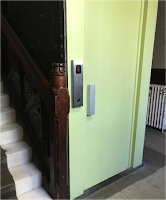
Figure 1. A Department 
Elevator. This photograph 
shows a very narrow entrance
doorway to an elevator.
The elevator is next to a
staircase with an ornate
carved wooden banister.
To illustrate my argument, I am going to start backwards, i.e. from the inside of institutional buildings. Figure 1 is of an elevator - possibly one of the most common environmental adjustments many universities have implemented in their respective buildings. The pictured elevator has purposefully been chosen as an example because of the practicalities that accompany its very presence. Whilst I do not know for certain the original purpose for the installation of this particular elevator, I am going to assume it was in response to policy / legislation surrounding accessibility1.
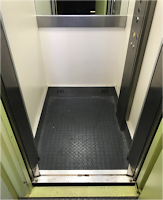
Figure 2. Inside a
Department Elevator. This
photograph shows the inside
of the elevator depicted
in Figure 1. The interior of
the elevator is very small.
The featured elevator, however, is impractical. An adult wheelchair would struggle to fit inside (see Figure 2), and self-propelled wheelchairs would definitely not fit. Yet, fitting inside the elevator is a secondary issue - first and foremost, individuals with mobility considerations would have to find a way to actually reach the elevator. To reach the featured elevators for example, an individual would have to navigate the steps in Figure 3; there is no alternate entrance and a ramp cannot be fixed to the steps due to the steepness and available space in front of them.
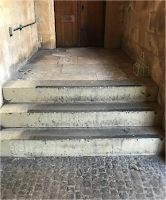
Figure 3. Stairs to Departmental
Building. This photograph
shows 3 steep stone steps
heading up to wooden double
doors.

Whilst I recognise that most institutions have more practical elevators, many have less accessible entrances. At a growing number of institutions, revolving doors, as illustrated in Figure 4, are being installed for energy efficiency measures, to prevent draughts. Such doors are not inclusive of individuals with mobility considerations. Having to find and use an alternate entrance is isolating and could even be exclusionary if one does not exist.
As Hannah Gibson so aptly wrote, access to spaces sends a message that ‘certain bodies are more welcome than others … [and] that they are inferior to [more] able-bodied individuals’. With well-known governmental initiatives such as Widening Participation (WP)2, access boundaries should not need to be pushed to make HE more inclusive. In contemporary society, inclusive access should be the norm.
I have never self-identified as ‘dis’abled, mostly because I have never previously been made to feel so. However, having moved to Cambridge, I now recognise that modern structures such as accessible elevators, automatic/light doors, and relatively flat pathways, are luxuries. Needless to say, considering basic access is yet to be conquered, accessible teaching/meeting rooms and mobility-friendly accommodation are even more rare.
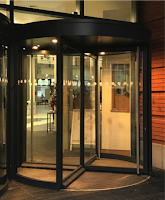
Figure 4. A University's revolving
doors. This photograph shows
a revolving door split into
4 narrow sections at the
entrance to a building.
I cannot escape the feeling that had I needed to rely more robustly on others, or been unable to come and go as I pleased without an entourage or timed assistance, I may have identified and felt differently. In this context, I am fortunate that my first experiences of HE were not made to be exclusive, and as a result I was enabled to reach my full potential. Now, in the words of Prof. Sara Ahmed (2006: 62), I am forced to acknowledge that ‘[w]hen bodies take up spaces they are not intended to inhabit, something other than the reproduction of the facts of the matter happens’; entrances inadvertently promote segregation, inaccessible elevators deny individuals with mobility considerations access, and thus boundaries are reinstated.
References:
Ahmed S, (2006). Queer Phenomenology: Orientations, Objects, Others. Duke University Press. USA.
Armstrong C, (2008). What you need to know about widening participation. [online] Available from: http://www.jobs.ac.uk/careers-advice/working-in-higher-education/1146/what-you-need-to-know-about-widening-participation Accessed: 27th August 2018.
Footnotes:
1. see the Equality Act 2010.
2. The aim of WP is to enable and encourage access to HE by offering opportunities to under-represented groups within the general population. Under-represented groups traditionally include which includes people with disabilities (Armstrong, 2008).
About the Author

Portrait photograph of Amarpreet
smiling into the camera with a
cityscape sunset in the background.
Amarpreet Kaur (@lioness1992) is a PhD Student at the University of Cambridge in the Department of Sociology. Amarpreet's research focuses on human germline genome editing in relation to disease and disability.

Sunday, 18 March 2018

Disableism in Academia

Written by Sonali Shah 
Disablism in academia has struck me down twice since I got my PhD and started on the academic career ladder. I am currently in the middle of the second bout, which I will go into later. First, let’s rewind my career trajectory to 2010, when my Nuffield Career Development fellowship in Disability Studies ended. Although I had been at my institution for three years, earned a pretty positive reputation in disability studies and been returned to REF 2008, no other opportunity was found for me and I became unemployed. The fact that I was in the middle of writing my third research monograph (co-authored by a non-disabled prof in Disability Studies – as they all seem to be) earned me an associate position with access to library resources and very minor bits of paid work. During this unpaid break of 18 months, the research monograph was published and I submitted an Economic and Social Research Council (ESRC) research grant proposal and did some voluntary work at the World Health Organization (WHO). Just before my internship at the WHO, I secured a 3 year university research fellowship within the same institution, which would start when I returned. Before my interview, I was awarded the ESRC grant I had applied for, which was obviously very attractive to the University and got me the job. While in that role, I was managing large grants and other staff, convening and teaching Masters courses and supervising undergraduate and Masters students.
So, 2 years, 3 books and 10 articles later, I wanted a promotion like my non-disabled colleagues who, while I was unemployed for 18 months, had zoomed past me on the academic career ladder. I thought it would be a good opportunity to ask for promotion as I was already working at a Grade 8 level doing the same work as other Grade 8 staff and yet I was still Grade 7. However, I was discouraged from applying for promotion by my line manager. A new post came up in the Centre for a Grade 9 Lecturer. My line manager said I should apply. I got an interview. I was not successful. Later I learned that the staff on the panel and in the Centre already knew I would not be successful, even before the interview.
After two years in this research post in Disability Studies, I applied for a Lord Kelvin Adams Smith (LKAS) fellowship with a research centre in Scotland. This was a four-year fellowship with promises of a permanent post if all objectives were met - teaching, publications and research. Again, I had a research grant under my belt. Again, I got the job and took the grant with me. My previous institution was a little taken aback when I left and took most of the grant with me, but my new employer agreed to employ me at Grade 8. On a personal level, this decision to take a post in Scotland meant finding an accessible flat in Scotland, finding personal assistants in Scotland, and commuting from my home in England to Scotland and vice versa every week. The question of moving to Scotland was not an option at that stage as my husband had a permanent job in England. So a commuter I became, with two cars, two beds, two sets of Personal Assistants, two lives, and many, many air miles, but that is another story. I wanted this job, a chance to shine and to have a permanent contract; or so I thought! I was one of 6 LKAS fellows in the faculty. I was one of three women, but the only BME woman, and the only BME disabled woman.
Fast forward to year four of the fellowship; feeling positive, with 4 more publications, 3 years convening and teaching an MSc course with very positive student feedback and a book contract, I thought I had built enough of a reputation to progress to a permanent post like my 5 fellow LKAS colleagues. While I had not managed to secure any large funding grants, I had submitted several large grant applications with colleagues. In most cases we had passed the first stages. This was not unlike the other LKAS fellows. However, unlike the 5 other LKAS fellows, I was facing multiple barriers to do what I needed to do and get where I needed to go. For instance, the course I taught was on the 9th floor of a tower block and when there was a fire alarm in week 5 during the class, no one came to check I could get out. I couldn't so I stayed there! Another difference was when I was invited to a single candidate interview to progress to a lectureship post, the decision had already been made to make me redundant. That was the second swipe, knocking me off the career ladder once more.
Although my new book 'Global Perspectives of Disability Violence and Gender: A Life-course and Human Rights Approach' will be published by Routledge in May, and I do not have the stress of academic life, I get angry about having my upward career trajectory constrained every 4/5 years until I reach another turning point. It's frustrating because my personal agency seems to be overshadowed by disabling structures and lack of enabling policies for disabled staff. I am not unique here, but this means that the field of Disability Studies is mainly run by non-disabled academics.
About the Author

Dr Sonali Shah is committed to research, scholarship and teaching that matters and makes a positive impact to the global challenges of equality, inclusion, health and social well-being of disabled people across intersectional identities and the life course. She graduated with a PhD in Occupational Psychology and Disability at Loughborough University in 2002. Her forthcoming co-edited collection, Disability, Gender and Violence (Shah and Bradbury-Jones. 2018) brings together academics, practitioner and survivor voices from across the world to discuss experience of violence, barriers to disclosure and support for disabled women from childhood to older life.