Showing posts with label HigherEd. Show all posts

Monday, 22 October 2018

Pushing the Boundaries: Making the Exclusive Inclusive

Written by Amarpreet Kaur 
Having completed my BA at a very modern and inclusive institution, moving to Cambridge was an eye-opening experience. I moved to Cambridge at a time when I was not worried if I would be able to walk the next day, when being wheelchair-dependent was not an imminent possibility. However, living with a degenerative condition and having passed through that very fog just before my arrival in Cambridge mean that accessibility and inclusivity are never far from my thoughts in this city.
For those with mobility considerations, whether chronic or temporary, environmental structures can make the world of difference. Such structures often go unappreciated and are taken for granted until they cease to function / exist. Before anticipating my move to Cambridge, I certainly never truly realised how fortunate I had been in my previous academic environment. In this post, I write to critically challenge whether physical access structures to academic institutions are actually practical and inclusive, and to increase discussion on boundaries that should be pushed so that the exclusivity of higher education (HE) can become more inclusive.
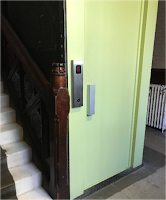
Figure 1. A Department 
Elevator. This photograph 
shows a very narrow entrance
doorway to an elevator.
The elevator is next to a
staircase with an ornate
carved wooden banister.
To illustrate my argument, I am going to start backwards, i.e. from the inside of institutional buildings. Figure 1 is of an elevator - possibly one of the most common environmental adjustments many universities have implemented in their respective buildings. The pictured elevator has purposefully been chosen as an example because of the practicalities that accompany its very presence. Whilst I do not know for certain the original purpose for the installation of this particular elevator, I am going to assume it was in response to policy / legislation surrounding accessibility1.
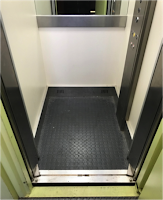
Figure 2. Inside a
Department Elevator. This
photograph shows the inside
of the elevator depicted
in Figure 1. The interior of
the elevator is very small.
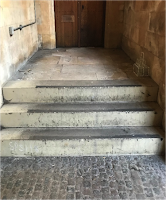
The featured elevator, however, is impractical. An adult wheelchair would struggle to fit inside (see Figure 2), and self-propelled wheelchairs would definitely not fit. Yet, fitting inside the elevator is a secondary issue - first and foremost, individuals with mobility considerations would have to find a way to actually reach the elevator. To reach the featured elevators for example, an individual would have to navigate the steps in Figure 3; there is no alternate entrance and a ramp cannot be fixed to the steps due to the steepness and available space in front of them.
Figure 3. Stairs to Departmental
Building. This photograph
shows 3 steep stone steps
heading up to wooden double
doors.

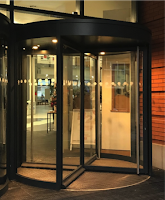
Whilst I recognise that most institutions have more practical elevators, many have less accessible entrances. At a growing number of institutions, revolving doors, as illustrated in Figure 4, are being installed for energy efficiency measures, to prevent draughts. Such doors are not inclusive of individuals with mobility considerations. Having to find and use an alternate entrance is isolating and could even be exclusionary if one does not exist.
As Hannah Gibson so aptly wrote, access to spaces sends a message that ‘certain bodies are more welcome than others … [and] that they are inferior to [more] able-bodied individuals’. With well-known governmental initiatives such as Widening Participation (WP)2, access boundaries should not need to be pushed to make HE more inclusive. In contemporary society, inclusive access should be the norm.
I have never self-identified as ‘dis’abled, mostly because I have never previously been made to feel so. However, having moved to Cambridge, I now recognise that modern structures such as accessible elevators, automatic/light doors, and relatively flat pathways, are luxuries. Needless to say, considering basic access is yet to be conquered, accessible teaching/meeting rooms and mobility-friendly accommodation are even more rare.
Figure 4. A University's revolving
doors. This photograph shows
a revolving door split into
4 narrow sections at the
entrance to a building.
I cannot escape the feeling that had I needed to rely more robustly on others, or been unable to come and go as I pleased without an entourage or timed assistance, I may have identified and felt differently. In this context, I am fortunate that my first experiences of HE were not made to be exclusive, and as a result I was enabled to reach my full potential. Now, in the words of Prof. Sara Ahmed (2006: 62), I am forced to acknowledge that ‘[w]hen bodies take up spaces they are not intended to inhabit, something other than the reproduction of the facts of the matter happens’; entrances inadvertently promote segregation, inaccessible elevators deny individuals with mobility considerations access, and thus boundaries are reinstated.
References:
Ahmed S, (2006). Queer Phenomenology: Orientations, Objects, Others. Duke University Press. USA.
Armstrong C, (2008). What you need to know about widening participation. [online] Available from: http://www.jobs.ac.uk/careers-advice/working-in-higher-education/1146/what-you-need-to-know-about-widening-participation Accessed: 27th August 2018.
Footnotes:
1. see the Equality Act 2010.
2. The aim of WP is to enable and encourage access to HE by offering opportunities to under-represented groups within the general population. Under-represented groups traditionally include which includes people with disabilities (Armstrong, 2008).
About the Author

Portrait photograph of Amarpreet
smiling into the camera with a
cityscape sunset in the background.
Amarpreet Kaur (@lioness1992) is a PhD Student at the University of Cambridge in the Department of Sociology. Amarpreet's research focuses on human germline genome editing in relation to disease and disability.

Saturday, 10 December 2016

PhD funding during illness: cancer, consequences & suggestions for change

Written by Claudia Pama
The last thing I wanted this blog post to become is some whining account of my personal experiences, but if you sense any of that while reading it, I sincerely apologise and greatly admire your perseverance if you make it to the end. At the same time, I really hope you do (make it to the end, that is), as it’s not about my experiences (which solely function as an example), but about changes that should be made to a system where PhD students who fall ill are currently being punished for doing so.
Brace yourself (admittedly, it's rather long, too).
The message that you have cancer is never easy to digest, and the timing is never right. I received mine on an evening in February 2015, while pressing my phone against my ear to identify the words my oncologist was uttering (‘I’m very sorry to bring the bad news’, ‘what stage is it?’, ‘we can’t tell, you will have an MRI to determine that’, ‘can it be terminal?’, ‘I’m sorry, we don’t know at this point’, and so on), as I was standing in a busy London street. Just a couple of weeks into my second lab rotation (part of the PhD programme I am currently enrolled in), I realised that the next months would require all my energy and organisational skills. Several doctor appointments, an MRI scan, discussions, decisions about my exact treatment and sketching a general action plan for the next weeks followed.
On the bright side, it turned out my cancer was an early stage, and I was able to receive a specific type of surgery (most likely not readily available to me back home). What’s more, I was positively shocked by all the support I was given from friends and those that didn't even know me that well – Cambridge felt like the best place to get cancer (or, more accurately, the least bad one). Largely because of this I managed to finish my rotation successfully, and arranged a period of medical intermission, starting on the day of my surgery (planning an intermission requires some effort, including the needed paperwork, medical letters and meetings with several people - while it’s no fun to do these things, most people were very supportive throughout this process).
In the chaos of arranging things and coping with the situation, I didn’t quite check the regulations of my funding bodies in too much detail (not that I had much choice anyway; the treatment plan was set up in Cambridge and I needed to get time out for treatment and recovery). Little did I know that, after politely informing them about my medical intermission, one* would reply by stating that this would affect my maintenance payment, and that any maintenance paid during this period was officially to be refunded. This was followed by some options, which effectively included multiple scenarios of the same one (pay back now, pay back later, pay half of it now, half of it later, don’t receive funding during a subsequent term, etc.), ending with the wonderfully paradoxical comment ‘the choice is yours’.
After more e-mail conversations (during which I explained my situation, stressing that my treatment had to be completed in Cambridge and I was fully dependent on my scholarships, in reply hearing that unfortunately no hardship or extension funding was available either), we eventually came to an ‘agreement’: instead of paying back my maintenance stipend during my intermission (which I couldn’t afford to do), I will be left without funding for the last term of my PhD (I still need to find a suitable solution). Of all my ‘choices’, this seemed to be the least bad one. As you can imagine, discussions like these are the last kind you want to engage in while being stressed about your health, work, finances and future, but unfortunately they seem to be more common than we would want them to be.
During the intermission period, I couldn’t wait to start my planned PhD experiments as soon as I was fully recovered. Although I knew that something wasn’t quite right about the way my funding was arranged, I didn’t really know anyone in a similar position and felt slightly powerless as an individual. Yet here comes the beauty of our digital era: one day my friend Edwin (a PhD student at the University of Oxford) wrote this blog post about his experiences, and I messaged him immediately. It turned out that he was in touch with Stella, who is doing a PhD at University College London and has just been through treatment herself. It made us realise that we’re not the only ones going through this, and what’s more, we’ve either experienced issues with funding bodies ourselves, or heard stories of others going through something similar. That’s when we decided to write a correspondence letter to Nature, published just over two weeks ago.
The question arises about what would be a reasonable solution. There is wide heterogeneity amongst funding bodies when it comes to medical leave; some fund part of it, some none. In our correspondence we suggest that PhD students should have the same rights as academic staff when it comes to medical leave (e.g. six months of paid sick leave) – in the end they essentially work like full time employees, so why shouldn’t they be treated as such? Alternatives already exist, one example being the Marie SkÅ‚odowska-Curie programmes for PhD students. The European Commission requires that grantees are offered a staff contract, thereby protecting their rights to sick leave. We propose that other UK funding bodies should also provide such basic rights with their grants, at the very least including a decent sick leave arrangement.
One final thing – if you are one of the unlucky ones going through something similar right now: don’t despair. Ask everyone for support; your supervisor, boss, tutor, mentor, College, friends – there might be help available that you are not aware of until you ask. Each problem has a solution, and chances are you will find it when you keep searching. In the same way, we hope that by raising awareness, changes will be made to the current situation, where PhD students who fall ill are receiving a double whammy. (Now, dear reader, you truly deserve my endless admiration by making it to the end of this blog post: thank you!).

*I won’t mention the exact funding bodies involved, and I am grateful for receiving funding from all my sources in order to complete a PhD degree. However, it’s essential to give specific examples like this one to raise awareness of the issue.

About the Author
Claudia Pama is a second year PhD student at the University of Cambridge.

Achieving Greater Acceptance in Academia

Based on an interview with Ian Shipsey 
I grew up in a working class district on a notorious council estate (housing project) in London's East End. I was hearing at that time. My high school had 180 students per year. Only two of us went to university. My parents had left school at 16. As far as I am aware none of my fellow students had parents who had attended university either. I went to the local university; Queen Mary, in London to study physics. I then took a PhD in particle physics at Edinburgh where Peter Higgs was one of my teachers. Shortly after arriving at CERN, the main particle physics lab in Europe, I fell in love with a wonderful Italian physics student who was heading to the US for a PhD so we began a transatlantic relationship until I had completed my PhD then I went to America to join Daniela. Daniela and I married and have one child. Shortly after getting married, while Daniela was still a student and I was a postdoc and both of us were working on the CLEO scientific collaboration at the Cornell Electron Storage Ring (CESR) a particle accelerator at Cornell University, I contracted acute myelogenous leukemia and was treated by a remarkable team of doctors and nurses at the Cornell University Medical School in NYC for more than one year. An industrial strength dose of chemotherapy beat the cancer but left me without an immune system and a medically necessary dose of broad spectrum antibiotics protected me until my own immune system had returned. A side effect off the antibiotics was irreparable damage to the hair cells in both cochleae resulting in severe sensorineural hearing loss.
Although still a postdoc I had already accepted a tenure track assistant professorship before becoming ill. I was very fortunate, had the timing been different and I had become ill before job season had commenced I would not have had that position and would have been regarded as unemployable by many. I accepted the job about a week before any symptoms appeared. The postdoc was at Syracuse University and the faculty position at Purdue University. After recovering enough to take up my new position about a year later, I then moved to Purdue which is about 120 miles (180 km) south of Chicago in Indiana and Daniela came too as a postdoc.
The unconscious assumption of able-bodied people is that deaf people are less able to teach or conduct research. Being underestimated is OK up to a point. In my field in the US it is typical to take one or two postdocs, each of 3 to 4 years duration, before becoming an assistant professor. I had only been a postdoc for 2.5 years when I was offered the job at Purdue (and jobs at other schools) so I was considered very promising. Purdue was a big physics department with about 60 faculty and about 57 of them had never met me as hearing person. They thought life had been dealt a very tough hand, they were kind and empathetic but they found it hard to consider me any longer as promising.
It was assumed I could not teach and nobody was quite sure what to do so I was left to my own devices. I did some research partly funded by the start-up given to me by Purdue and then wrote three proposals for young scientists, two of which were successful and resulted in very significant funding. One was the National Science Foundation National Young Investigator Award which that year only two people in the US were given in my area. Having won the awards, it is customary to be considered for early promotion to tenure to pre-empt other universities from poaching but in my case I had no teaching record so I could not be promoted. To fix that I was given an opportunity to teach which I had no experience of doing. The teaching experience was wonderful. Being deaf served to make me a better teacher because I strived harder to be especially clear so that the number of questions students had tended to build and extend the material I was explaining rather than asking for further explanation of what I had already "explained". At the end of the semester I received the physics professor of the year award. The award is given by the physics students at Purdue including those I had taught. It means to this day a great deal to have received it. The award helped to establish my ability as a teacher and I was promoted to tenure. Meanwhile Daniela became an Assistant Professor and our daughter Francesca was born.
When I moved to Purdue I continued to work at Cornell for most of my research. A small network of friends on CLEO, all able-bodied, took it in turns to help me by taking notes at meeting. They said that in front of their eyes they saw a transformation in my ability to contribute, often decisively, to discussions. Eventually this led to I and several others developing some new ideas, and to me being elected the scientific leader of the collaboration and the award of very substantial funds to conduct a new program in particle physics at Cornell. It was while leader of CLEO that I explored cochlear implants and received one.
Prior to my cochlear implant, communication with students especially in large classes was difficult. To solve the problem I asked students to write questions down on paper and pass them up to the front of the class. Students in large-enrollment physics courses are often very shy about standing up and asking questions; writing the question made it anonymous and hence easier for students to ask questions. The method was subsequently tried out by some hearing faculty to good effect. I sometimes communicated with my own doctoral students through bone conduction; the student and I both leaned our heads against a wall and the student talked into the wall and I could sometimes comprehend what was being said though the vibrations combined with lip reading. In any situation where I was not a focus (such as in the audience at a conference) understanding what was happening was very difficult so I avoided conferences and did not in general network. Conversations were difficult. Hearing people feel awkward speaking to deaf people first because nobody enjoys saying something and not being understood and second very few hearing people have had any experience of talking to a completely deaf person.
There were two turning points in my ability to communicate. The first was that physicists in general are very interested in the research of other physicists. In the CLEO collaboration at Cornell, everyone knew me as a hearing person who became deaf. This meant that the deaf stereotype was not applied to me so strongly by that group and there were several faculty at Cornell who proactively began to help me with communication, offering to take notes for me. In addition, I began to request stenographers at Purdue and Cornell.
At conferences today, I simply sit in the front row and if I cannot understand I ask people to speak louder and slower and to repeat what they have said but I would not have had the confidence to do that in the early days.
I did not find it easy to gain access to stenographers as they are few and expensive. In principle the deaf students and I had the right to a stenographer, but there were more of us than there were stenographers. I used stenographers occasionally until 2003 when I had the cochlear implant. It’s quite likely that there are many parts of the world where students who are unable to hear do not have sufficient access to stenographers today.
In my field, some of my postdocs and students will typically be based at CERN. Communication remotely was very difficult before I received the implant. It was mostly text based (shared electronic logbooks) and email. Now we communicate via Skype and video conferencing. On experiments in particle physics everybody takes it in turn to run shifts operating the experiment. After I lost my hearing, but before I received a cochlea implant running shifts was hard for me, as although we have a lot of visual information when we run shifts, there are also purely audio cues such as alarms that it would not be possible for me to hear. However, colleagues happily and kindly installed visual equivalents (warnings on a computer screen when the alarm sounds). This enabled me to feel comfortable taking the shifts as with the accommodations that had been made I could now do the job as well as when I could hear and as well as other physicists. Much of the work I do is in my office, but when in the laboratory the work is visual and I have many wonderful students and postdocs and engineers and technicians working with me and helping me, almost all are able-bodied.
I find it difficult to understand amplified voices. This is because amplification distorts voice as well as making it louder. For hearing people, the noticeable effect is the volume increase whereas the distortion is usually unnoticeable or at least not distracting. For many with a cochlear implant the distortion dominates any gain in volume. This is because cochlear implantees have less sense elements than those with natural hearing so our auditory pattern recognition is inferior. If the auditorium is small I request people do not use a microphone to ask questions but if the auditorium is large I ask the audience to write down their questions.
Before I had my hearing restored I was elected three times to be the leader of the CLEO Collaboration, a group of 21 universities and about 180 scientists at Cornell. After I received a cochlear implant, I became Head of the LHC Physics Center at FNAL and was elected Chair of the Collaboration Board of CMS (one of the two experiments at CERN that discovered the Higgs). I was hired at Oxford to become Head of the sub-department of Particle Physics in 2013 many years after I became deaf and had a cochlear implant.
I need no special resources now except the cochlear implant. I do ask people to look at me when they are speaking to me, and when people mutter I ask them to speak clearly. I do not participate in the sign language community because nobody I knew professionally or outside work could sign. I have met with signers though to talk about my experiences with the aid of SL interpreters. Since receiving the implant, I have found that I am much more likely to be placed on committees and more frequently asked to give talks and more generally given opportunities as it has become easier to communicate. Throughout my career in the US and UK my colleagues have always been very supportive.
It is a real phenomenon that many scientists feel conflicted about acting publicly as a scientist with a disability because there is a risk they might become less known for their science and more known for their activism. The same thing happens when an academic engages significantly in outreach to the public or to school kids. One starts to become known for outreach and academic colleagues will question if you are a devoted academic. My strategy to deal with this is as follows: if I am invited to an event to give a talk because I am deaf, I concentrate mostly on my work, what I have accomplished and how rather than concentrating on the disability. The result is that people see an example of a practicing scientist passionate about their work who happens to be deaf. With this strategy I am not trying to trivialize the disability, I am trying to show that its effects can be overcome.
One of my doctoral students had a very severe speech impediment. He was an outstanding student with outstanding grades, yet he had difficulty to find a professor to supervise his thesis. He was very bright and we did great work together. Looking back now it seems to me a person with a disability is sometimes more sensitive to the difficulties faced by others with disabilities, and in some cases this makes them better prepared and more confident they can effectively help and supervise the student. That is certainly the reason I took the student. I did not see the disability as anything other than surmountable.
I generally disclose my deafness. I am proud of it. O Course, I would prefer to have natural hearing but I am inspired by the incredible technology of a cochlear implants that, when married to a human brain, can enable an implantee to understand much of the auditory world. To achieve greater acceptance of disabled people in academia, we need more role models. We need access to the right types of support so that people with a disability are not disadvantaged by that disability to the extent possible.

 About the Author
Ian Shipsey is the Henry Moseley Centennial Professor of Experimental Physics and Head of the Sub-Department of Particle Physics at the University of Oxford and Professorial Fellow at St. Catherine’s College, Oxford.

Thursday, 18 August 2016

Lessons from Writing a PhD with a Chronic Illness

Written by Amber Davis 

I wrote the first half of my PhD when I was healthy, or at least healthy enough to function ‘normally’. I suffered from low energy, and had a collection of intractable seemingly unrelated health issues pop up regularly, but they were manageable. With lots of self-care I was all right. That changed from one day to the next when the disease that had been lurking in the shadows decided it was on top and my health crashed spectacularly. I didn’t find out until over six years into it what that disease was: Lyme disease (Borreliose), a bacterial infection caused by a tick bite, as well as co-infections, that weaken the immune system and mess with every other bodily system you can think of. In my case it looks a lot like chronic fatigue syndrome or M.E. (I am aware of the controversies surrounding these labels and conditions. Not saying these are the same). Unfortunately: no cure, though there are things that can be done to improve, maybe even get to remission. In the meantime though, life goes on, which was the first thing I learned, even before my diagnosis, living with what I still hesitate to call a ‘chronic illness’. Where before my falling ill I might have a life crisis and I would lay low and it would solve itself with time and a bit of effort, no such luck this time: seems I would have to go on living with this massive part called health unresolved. After years of being too ill to do anything at all, let alone think about work, I decided I would try to finish my PhD. I had to go about it strategically, as there was not a drop of energy to waste. This is what I learned:
  1. Do You Really Want to Be in Academia?

    Living with a limiting health condition means having to be true to what you really want, as anything else no longer seems to work. There is far less leeway. Far less room for manoeuvre. That seemed to be very much the case for me, anyway. Having to deal with severe energy limitations, I noticed the only things I successfully managed were those that lit a spark. Finishing the PhD was not at all self-evident. To be honest, I didn’t much care about it for years: I had bigger fish to fry, namely trying to get my health back to a place where I would be able to enjoy life instead of enduring it! The PhD seemed insignificant in comparison. At some point, however, I realised I was still interested in my project, and figured I had nothing to lose. There was a chance I might manage (though I didn’t dare say this out loud) so why not try? Most importantly, when I decided to finish my PhD it was because I felt compelled to. That didn’t mean it was in any way an easy road, or that I didn’t have doubts about it - in many ways it was a bit of an insane plan - but I knew I wanted to give it a go, at least
    I believe the essential question to ask, when you are at a cross-roads with your health and work life in academia, is: “Do I want to be here at all? Do I want to be in academia?” That difficult question has to be answered before bothering with: “How am I going to manage?” Being ruthlessly honest about motives and circumstances, about whether an academic position adds to your being fulfilled, whether it is good for you, or whether it drains you further, and whether continuing down the same road is feasible, is required. Circumstances change: maybe academia was right for you at one point, but no longer is. Or conversely: maybe your health meant you had to drop out for a while, but has now improved to such a level that you will manage, and you find yourself longing to get back. Learning to distinguish when a ‘yes’ is a real, true yes, is very much a learnable skill. One way of knowing is to pay attention to how you feel about certain options: if an option such as finishing your PhD feels expansive, exciting, even if it may be daunting, that indicates a ‘yes’. If it makes you shut down, even though you want yourself to pursue it for reasons such as not wanting to be a ‘quitter’, feared loss of status etcetera not so. It is OK to quit, even if fellow academics are not likely to respond favourably to your doubts about pursuing an academic career. Similarly: don’t let anyone dissuade you from working in academia, or pursuing a project. Give yourself permission to make your own decisions.
  2. Prioritise Your Work and Do It Your Way

    For me staying in academia meant I had to find a way of working that wouldn’t exhaust me further. In practice that meant being strict about my work hours. In the morning I would work three hours, and that meant absolutely no interruptions. If I had energy left, I would also work an afternoon session. That way of working, of making the most of the energy I had by focusing in, worked very well. (It works well also if you have no energy limitations. Focus is everything.) But it meant a lot of boundary setting. No Internet surfing or picking up my phone during these hours. I made a point of switching everything off, including the Internet, which helped. I also started working in 45 minute intervals, further improving focus. Whereas before I wasted a lot of time in the twilight zone of distraction, those days had to be over for me to be able to function at a level to get my work done. These new work habits made a world of difference. A crucial aspect also was working for no longer than was sustainable. My old habit was to push past the fatigue, and to try to keep going no matter what, even if it was going nowhere. It took some courage to change that and indeed stop after what felt like not long at all. Saying: ‘this is enough for today’ can be daunting. Over the long run, though, I learnt to trust my new habits, and it got easier. It actually worked!
    Mentally a new habit I had to form was to not engage so much with the negativity mindset (this is never going to work, what if my work isn’t good enough, I’m never going to meet that deadline, oh this is so slooooooow, why am I even trying etc.) that often comes with academic work, even without the added obstacle of illness or exhaustion. The worry was such a strain. It didn’t seem to solve much, either! What if I could train myself to skip the worry part? Seems a bit outrageous, and certainly doesn’t conform to norm seen the general tendency towards suffering and self-flagellation in academia, but it might free up some energy! Worth a try. Meditation was my method of choice to learn to not stay stuck in worry. (Practice, not perfection, always.) It helped me make my worries manageable by teaching me to be me be far more aware of how I was spending my emotional energy. It also helped me learn to shift my focus of attention to more positive states or activities when my worries threatened to get the better of me. Another practice that helped was truly engaging with what I was doing. It is quite impossible to be focused - say on working on a chapter - and worrying about it simultaneously (though no doubt I may have managed at times). I tried to be more aware of my focus, both in terms of what I was doing, and what I was thinking. Mindfulness basically.
    The other, very practical, thing I needed was time. Although I did finish my PhD much faster than expected once I got back on track, when I was at my most unwell working was out of the question. I had to ask my department for extensions again and again. I believe I was the person with the longest history of sick leave in the entire institute ever! Which leads me to the next point:
  3. Ask for What You Need

    Depending on your disability, illness, or other obstacle, you may need to inform your department/ supervisor/ colleagues of your situation. Academia is an odd place: on the one hand it tolerates diversity rather well, and people tend to be friendly and open-minded, on the other it can be a wildly competitive place, increasingly so, where everyone is madly competing for limited resources. Ideally we would be able to discuss our health issues freely, if necessary. Yet one immense burden of having a chronic (invisible) illness or disability is not being heard, or understood. In less fortunate cases you may even be bullied or taken advantage of, or as was the case for me: somewhat neglected. At some universities (often the more prestigious ones) I can’t quite wrap my head around the level of machismo and politics. In most a lot depends on the influence and willingness of the person in front of you.
    I generally believe in being open about your condition to the extent that practical considerations require. More if you have someone you particularly trust. In my experience people tend to respond well to concrete requests which may help you function, and being pragmatic about your needs is extremely helpful. I probably don’t need to tell you that chronic illness or disability is often so far out for people - even those who wish you well and want to help - that they simply cannot imagine what you might need. If we have the need part figured out for ourselves, it helps tremendously. It is so important. And please do advocate for yourself! I know I felt shame because I could no longer keep up, but at one point I decided that if at all possible I would try to not bother with the shame and guilt and negative emotions as much (being unwell was burden enough, thanks!) and I would go for what I wanted and ask for what I needed, without them, if at all possible. It was a wise decision. Thanks to a supportive supervisor I got much needed extensions of my PhD programme, again and again. Even so, I had a plan B. I was well aware that completed PhDs still meant income for Dutch universities, so I considered potentially finishing my PhD at another university than where I’d started in Italy, if an extension would no longer be granted.
    When negotiating, be strategic in who you choose to talk to. Unfortunately some people don’t ‘get it’ until they get it, and they are best avoided. Even so, one person blocking your path doesn’t mean the end of the road. Friendly networks are important in academia and knowing people will open doors. So do try to invest in finding the right people to know and collaborate with. Above all: do not let yourself be diminished by clueless people. This is your life. They have no say in it. And they certainly have no say about your worth. Do not let them mess with your head. I feel strongly about this. Being unable to conform can be hard on our self-esteem. I notice I do much better when I give myself the benefit of the doubt. In fact, I believe this is what we owe ourselves. And what allows us to be not so ‘disabled’ at all!
End of story: I did finish my PhD and it was well received, as the best thesis of the department that year (let me brag: best of 34 political science PhDs). I also finished it well within the deadlines, to my own astonishment I must admit. I came a long way with a few small habit changes and a lot of persistence! After finishing, I decided to leave academia, and teach young academics what I had learned the hard way. I now coach PhD students and other academics, and run an online course to support wellbeing and productivity in the world of academia. Do get in touch with your questions or story if you think I might be able to help.

About the Author

Photo of Amber Davis Amber Davis is a political scientist and academic coach and holds a PhD from the European University Institute in Florence. She blogs at www.amberdavis.nl which also hosts the HappyPhD online course that will help you write your PhD (almost) effortlessly.